Environment Design Habits: Change the Room, Not Your Resolve
Picture a bowl of sweets on your desk. Not out of sight, not in a drawer — right there, at arm's length, lid off. Now be honest about how many you'd eat by Friday. Environment design habits start with that uncomfortable truth: most of your behaviour isn't chosen so much as triggered by what's…
TL;DR
- Environment design habits work because your surroundings, not your motivation, quietly decide most of what you do.
- Reduce friction for good behaviours and add friction to bad ones — the effort gap does the heavy lifting.
- Willpower fatigues; a well-designed room doesn’t. Change the space and the behaviour often follows without a fight.
What’s in this guide
- What are environment design habits?
- Why does your environment beat your willpower?
- How do you use friction to change behaviour?
- Designing cues: making the good habit obvious
- How do you do habit environment design step by step?
- Practical environment design examples
- Common mistakes that quietly sabotage you
- Key takeaways
- Frequently asked questions
Picture a bowl of sweets on your desk. Not out of sight, not in a drawer — right there, at arm’s length, lid off. Now be honest about how many you’d eat by Friday. Environment design habits start with that uncomfortable truth: most of your behaviour isn’t chosen so much as triggered by what’s within reach.
We like to think of ourselves as the author of our actions. But the space around you is writing far more of the story than you’d care to admit. The good news? You hold the pen for the space too.
Real change isn’t magic, it’s mechanism. So let’s look at exactly how your surroundings shape what you do — and how to redesign them on purpose.
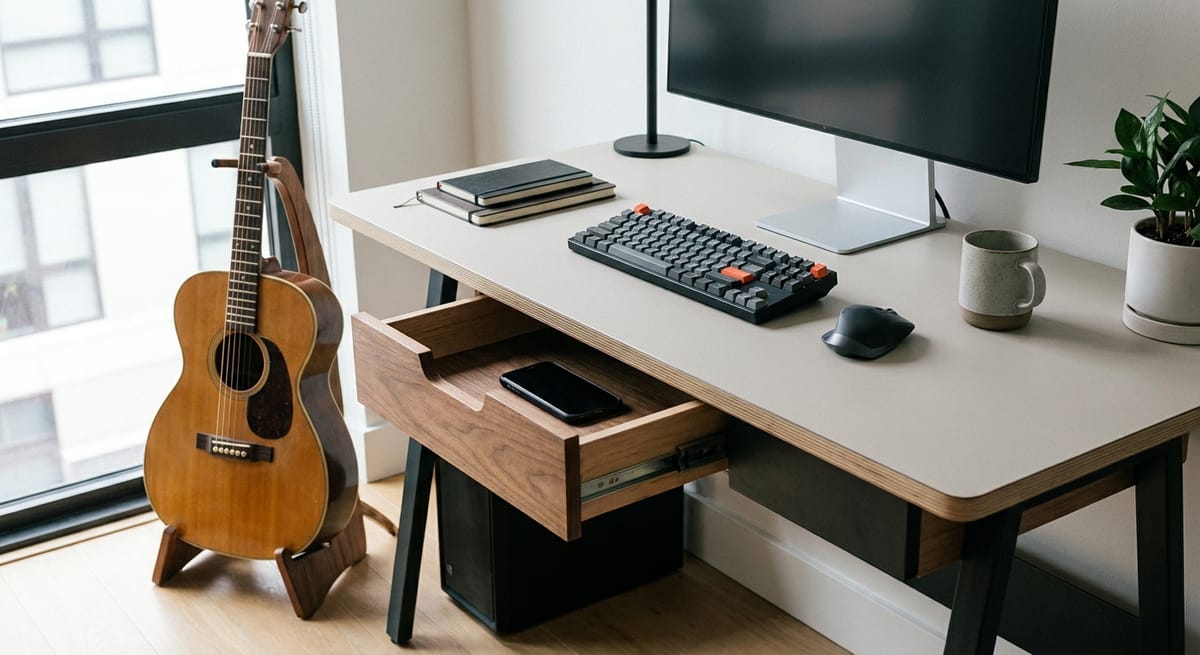 Your environment is a silent instruction sheet — this guide teaches you to rewrite it.
What are environment design habits?
Environment design habits are behaviours you shape by deliberately arranging your physical and digital surroundings, rather than relying on motivation. In plain terms: you make the good thing easy to reach and the bad thing awkward to reach, then let the space do the persuading.
The term draws on a simple behavioural principle — that we respond to cues in our field of view and act along the path of least resistance. As James Clear puts it in Atomic Habits, “Environment is the invisible hand that shapes human behaviour.” That’s the whole game in a sentence.
This isn’t a tidy-your-room platitude. It’s a mechanism. Once you understand the mechanism, the tools stop sounding like advice and start sounding like leverage. Instead of fighting a craving with clenched teeth, you remove the trigger that starts the craving in the first place.
Why does your environment beat your willpower?
Your environment beats your willpower because willpower is a finite, fatiguing resource, while a well-arranged space never gets tired. Every visible cue is a small decision demanded of you — and decisions drain you.
Here’s the clinical cousin of the problem: what feels like “weak willpower” is often just chronic exposure. The mere exposure effect shows we grow more drawn to what we repeatedly encounter. If the biscuits, the phone, the notifications are always in your line of sight, your brain isn’t lazy — it’s responding exactly as designed.
Research on cue-driven behaviour is well established. Wendy Wood, a psychologist at the University of Southern California, has spent decades studying habit; her work suggests that roughly 43% of daily actions are performed habitually, largely triggered by context rather than conscious intent (Wood, Quinn & Kashy, 2002). That number matters. It means nearly half your day runs on autopilot — and autopilot follows the terrain you’ve laid out.
This is also why leaning on grit tends to fail over time. If you’ve ever wondered why willpower fails, the short answer is that it was never meant to be your primary steering wheel. The environment is.
“You do not rise to the level of your goals; you fall to the level of your systems.” — James Clear
I’d push that one step further: your environment is the most physical system you own.
How do you use friction to change behaviour?
You change behaviour by adjusting friction — the number of steps, seconds and small efforts between you and an action. Lower friction for what you want to do more of; raise it for what you want to do less of. The behaviour tends to follow the effort gradient.
Think of friction as a dimmer switch, not an on-off. You rarely need to make a bad habit impossible — just annoying enough that the impulse fades before you act.
Reducing friction for good habits
- Lay out your gym clothes the night before, shoes by the door.
- Keep the water bottle filled and visible on the desk.
- Leave the guitar on a stand in the living room, not zipped in its case.
- Pre-chop vegetables on Sunday so the healthy meal is the fast meal.
Adding friction to bad habits
- Log out of social apps so each visit demands a password.
- Move the phone charger to another room overnight.
- Store snacks on a high shelf, in opaque containers, out of sight.
- Delete the shopping app; force yourself to open a browser and re-enter card details.
These are small numbers of seconds. But small friction, applied at the moment of impulse, is often enough. This is the heart of reducing friction in habits — and it pairs beautifully with temptation bundling, where you attach a want to a should.
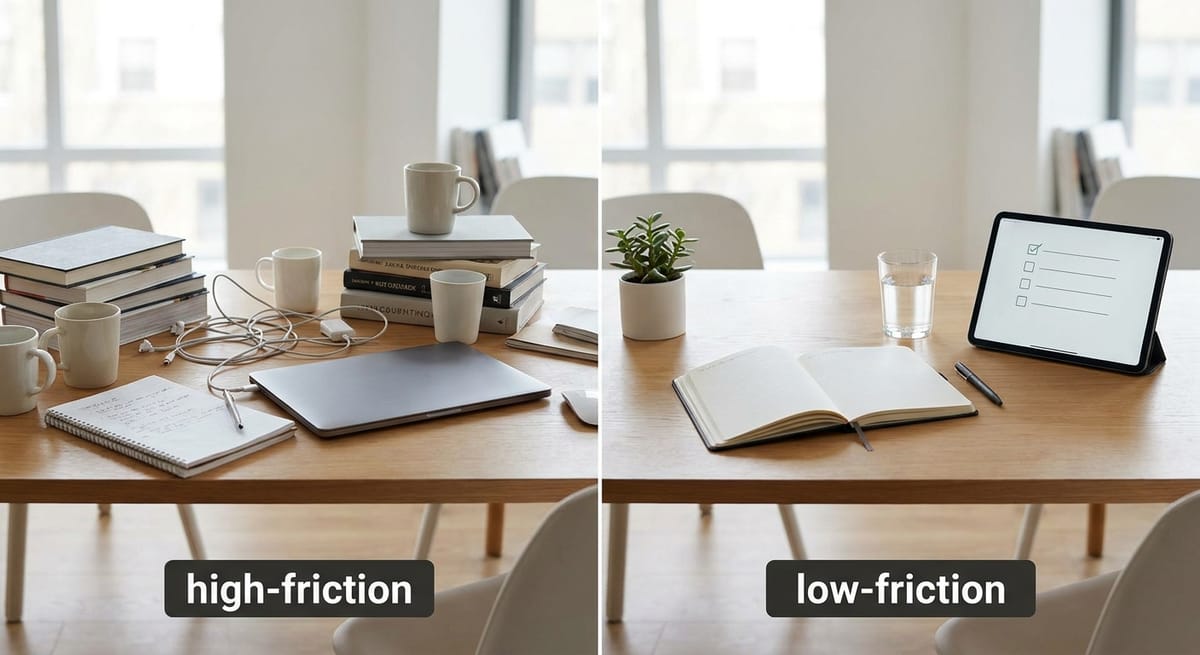 Friction is the dimmer switch of behaviour — adjust it and the habit shifts.
Designing cues: making the good habit obvious
A cue is any trigger that prompts a behaviour — a sight, a sound, a location. Designing cues means placing the reminders for your desired habit directly in your path, so the behaviour becomes the obvious next move rather than the remembered one.
The reframe that dissolves the self-blame here: you’re not forgetful, you’re under-cued. A resolution held only in your head is a cue with no anchor in the world. Give it a physical home.
One reliable way to do this is habit stacking — attaching the new behaviour to an existing, stable cue. “After I pour my morning coffee, I write three sentences in my journal.” The coffee is already reliable; the journal borrows its reliability. Below is how the two levers combine.
| Lever | What it changes | Everyday example | Best for |
|---|---|---|---|
| Friction | Effort between you and the action | Phone charging in another room | Breaking or curbing a habit |
| Cue placement | Whether the trigger enters your view | Book on the pillow | Building a new habit |
| Habit stacking | Anchoring a new habit to a reliable one | Stretch after brushing teeth | Making cues consistent |
| Temptation bundling | Pairing a want with a should | Podcast only while walking | Sustaining low-motivation habits |
Notice the symmetry: to build a habit, make its cue impossible to miss. To break one, make its cue impossible to see. Environment design habits live in that mirror.
How do you do habit environment design step by step?
Habit environment design is the deliberate practice of auditing one space, then rearranging its cues and its friction until a single chosen behaviour becomes the default. It runs on four principles and five steps: name the behaviour, map the space, plant the cue, tune the friction, then review the drift.
The name matters, because “tidy up and hope for the best” is not a practice. Habit environment design has a subject (one behaviour), a canvas (one space), and a test — did the behaviour happen without you having to negotiate with yourself? Everything else is decorating.
The four principles
Visibility beats memory. A habit you have to remember competes with everything else crowding your head. A habit you can see has already won that fight.
Proximity beats intention. Distance is measured in seconds, not metres. The guitar on the stand and the guitar in the cupboard are not the same instrument.
One space, one signal. A room that means work, sleep, and scrolling all at once cannot cue any of them cleanly. Give each space a single job where you can — even if “the space” is one corner of a desk.
Design for your worst day. A setup that only works when you’re rested and motivated isn’t a design, it’s a mood. Build for the tired version of you, because that’s the version who turns up most often.
The five steps
-
Name one behaviour, in the concrete. Not “read more” but “ten pages before the light goes off”. If you can’t picture it happening — where you’d be sitting, what you’d be holding — you can’t design for it yet.
-
Map what the room is currently instructing you to do. Stand in the doorway and list every object in your field of view, and beside each one write the behaviour it invites. Most rooms turn out to be beautifully cued for the habit you’re trying to break and entirely uncued for the one you want. That asymmetry is the diagnosis.
-
Plant the cue in your path, not in your plan. The object that starts the behaviour goes where you will physically meet it: trainers against the front door, the journal open on the chair you sit in. Then make the cue specific in time as well as space. Gollwitzer and Sheeran’s meta-analysis of 94 independent tests found that forming an if-then plan — if situation Y arises, then I will do X — had a medium-to-large effect on goal attainment (d = .65). An if-then plan is that cue planted in the calendar; the object is the same cue planted in the room.
-
Tune the friction in both directions at once. This is the step most people half-do. Taking steps out of the good behaviour while leaving its competitor untouched changes little, because the competitor was always the easier option. Remove steps from one side and add them to the other in the same sitting, and count them — twenty seconds each way is usually the whole intervention. If the first rep still feels heavy, shrink the behaviour until it doesn’t; the two-minute rule exists for exactly that moment.
-
Review after seven days, and expect drift. Environments regress towards convenience. The phone migrates back to the desk, the fruit bowl empties, the trainers get kicked under the coat rack. A five-minute weekly walk-through — is every cue still where I put it? — is what turns a one-off tidy into an ongoing practice.
Run the sequence on one behaviour and one space before you run it on five. Its value isn’t thoroughness; it’s that every step leaves you something to check. When the habit doesn’t take, you’ll know which step to go back to rather than concluding, wrongly, that you lack discipline.
Practical environment design examples
The fastest way to grasp this is to see it applied. Below are concrete redesigns you can copy this week, each targeting the cue-and-friction mechanism rather than your motivation.
Deep work
Clear the desk to a single task. Put the phone in a drawer in another room — not face-down beside you, where it still whispers. If you struggle here, the mechanics of attention are worth understanding; see how to stop phone distraction and the wider picture in deep work and the neuroscience of focus.
Eating well
Redesign visibility. In a well-known Cornell study, office workers ate significantly more sweets when chocolates sat in a clear jar on the desk versus an opaque one two metres away (Wansink, Painter & Lee, 2006). You didn’t change the person — you changed the shelf.
Sleep
Make the bedroom a single-purpose room. No screens on the nightstand, blackout curtains, a paper book within reach. The room itself becomes the cue for winding down.
Digital environments
Your screen is an environment too — arguably the one you inhabit most. Grey-scale the phone, delete apps from the home screen, and turn off badge notifications. Each is a small friction increase against the pull of the feed.
Common mistakes that quietly sabotage you
The most common mistake is redesigning your environment once and assuming it’s done. Environments drift — the phone creeps back to the desk, the fruit bowl empties, the clutter returns. Maintenance is part of the design.
- Relying on motivation to “top up” a bad design. If the setup needs constant willpower, the setup is wrong.
- Half-measures on friction. Face-down beside you isn’t in another room. The cue still fires.
- Ignoring the digital layer. A tidy desk with a chaotic phone is a locked front door and an open window.
- Fighting cravings instead of removing cues. That’s the old, exhausting way. Change the room, not the resolve.
And if a habit is genuinely stubborn, environment design pairs with deeper work on the trigger itself — see how to break a bad habit for the full loop. The point is not perfection. It’s stacking the odds so that on a tired, low-willpower day, the easy choice is also the good one.
Key takeaways
- Environment design habits shift behaviour by changing your surroundings, not your willpower — the invisible hand does the work.
- Roughly 43% of daily actions are habitual and cue-driven, so context matters more than motivation (Wood et al., 2002).
- Lower friction for good habits; raise it for bad ones. Seconds of effort at the moment of impulse are often enough.
- Make good cues obvious and bad cues invisible — the two are mirror images of the same principle.
- Your digital screen is an environment too; redesign it as deliberately as your desk.
- Environments drift, so maintenance is part of the design, not an afterthought.
Frequently asked questions
What are environment design habits, in simple terms?
Environment design habits are behaviours you shape by arranging your surroundings rather than relying on motivation. You make desirable actions easy and visible, and undesirable ones awkward and out of sight. Because nearly half of daily behaviour is cue-driven and automatic, changing what surrounds you often changes what you do — with far less internal struggle than sheer willpower demands.
How is environment design different from willpower?
Willpower is a finite resource that fatigues across the day; a well-designed environment doesn’t tire. Instead of resisting a craving in the moment, you remove or hide the cue that sparks it. This means the system, not your mood, carries the load. On low-energy days, good design keeps the easy choice and the good choice the same thing.
How quickly does changing my environment change my habits?
Often immediately for the cue itself — hide the sweets and consumption typically drops that same day. But durable habit change still takes repetition, usually weeks rather than days, as the new pattern becomes automatic. Environment design speeds this up by removing the friction and temptation that would otherwise derail you before the habit sets.
Does environment design work for digital distractions?
Yes, and it’s essential. Your phone and screens are environments you inhabit constantly. Deleting apps from the home screen, disabling notifications, greyscaling the display and moving the charger to another room all add friction to distraction. These small barriers interrupt the automatic reach for the feed, giving your intention time to reassert itself.
What’s the single easiest environment change to start with?
Move your phone out of the room during focused work and overnight. It’s a five-second change that removes one of the most powerful cues in modern life. Because the phone triggers so many automatic behaviours, relocating it tends to produce an outsized improvement in focus and sleep for almost no ongoing effort.
What is habit environment design?
Habit environment design is the practice of deliberately arranging a space so that one chosen behaviour becomes its default. You name a single behaviour, map the cues the room already sends, plant a visible trigger in your path, and adjust the friction on both the habit and whatever competes with it. The room then does the persuading.
Is habit environment design just tidying up?
No. Tidying makes a space look calmer; habit environment design makes a space produce a behaviour. The test is behavioural rather than visual — did the thing happen without an internal argument? A cluttered desk with the guitar on a stand serves the habit better than an immaculate one with the guitar zipped in its case.
Ready to build systems that don’t rely on grit? Explore our Habits collection for mechanism-first guides, or begin with Start Here to map your own change. The room you build decides the behaviour it gets — and now you know how to build it on purpose.